Subpixel Matching - Part I
[1]:
import math
import os
import sys

sys.path.insert(0, os.path.abspath('/data/autocnet'))

import autocnet
# Enable the GPU
autocnet.cuda(enable=True)

from autocnet import CandidateGraph

# The GPU based extraction library that contains SIFT extraction and matching
import cudasift as cs
# A method to resize the images on the fly.
from scipy.misc import imresize

%pylab inline
figsize(16,4)
Populating the interactive namespace from numpy and matplotlib
Create the CandidateGraph
Just like the other notebooks this cell creates the candidate graph. This also patches in functionality to the object on the fly. To get a handle on what is going on, checkout the Advanced 1. Extending the CandidateGraph notebook.
[2]:
# Create the candidate graph and enable a GPU
a = 'AS15-P-0111_CENTER_LRG_CROPPED.png'
b = 'AS15-P-0112_CENTER_LRG_CROPPED.png'

adj = {a:[b],
       b:[a]}

cg = CandidateGraph.from_adjacency(adj)

# Define a function to do the feature extraction.
def extract_features(self, arr, downsample_amount=None, **kwargs):
    total_size = arr.shape[0] * arr.shape[1]
    if not downsample_amount:
        downsample_amount = math.ceil(total_size / 12500**2)
    shape = (int(arr.shape[0] / downsample_amount), int(arr.shape[1] / downsample_amount))
    # Downsample
    arr = imresize(arr, shape, interp='lanczos')

    npts = max(arr.shape) / 3.5
    sd = cs.PySiftData(npts)
    cs.ExtractKeypoints(arr, sd, **kwargs)
    kp, des = sd.to_data_frame()
    kp = kp[['x', 'y', 'scale', 'sharpness', 'edgeness', 'orientation', 'score', 'ambiguity']]
    kp['score'] = 0.0
    kp['ambiguity'] = 0.0

    # Match the interface defined in the edge.
    self.keypoints = kp
    self.descriptors = des

    self['downsample_amount'] = downsample_amount

# Import the class and update it.  This updates the current instance of the CandidateGraph
from autocnet.graph.node import Node
Node.extract_features = extract_features

# Extract the features
cg.extract_features(thresh=1)
Match and Find Outliers
[3]:
# Match
cg.match()

# Apply outlier detection - see the above linked notebook if you are curious about what is going on here.
for s,d,e in cg.edges_iter(data=True):
    e.masks['ratio'] = e.matches.ambiguity <= e.matches.ambiguity.quantile(0.015)
    e.masks['score'] = e.matches.score >= e.matches.score.quantile(0.85)

# Compute the F Matrix
cg.compute_fundamental_matrices(clean_keys=['ratio', 'score'])
Subpixel Refinement
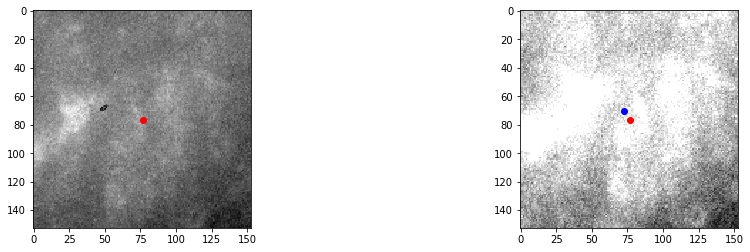
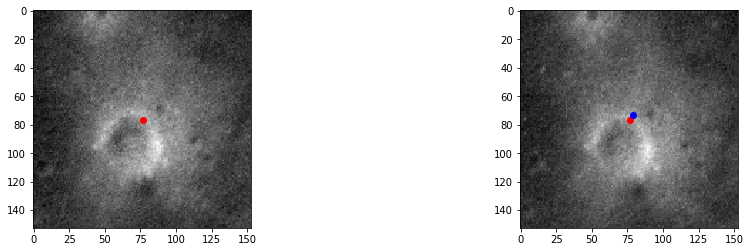
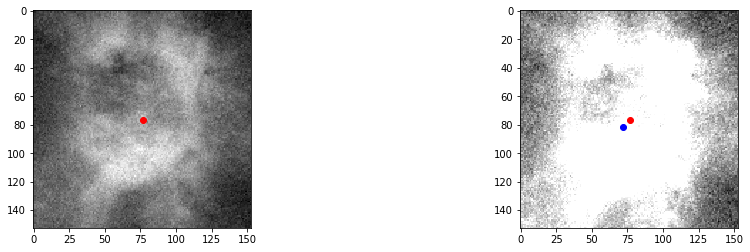
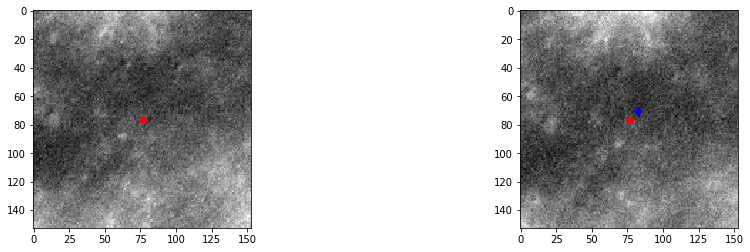
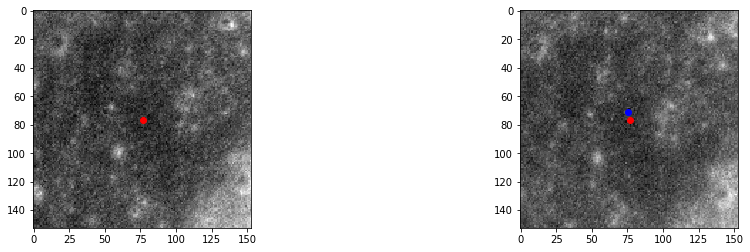
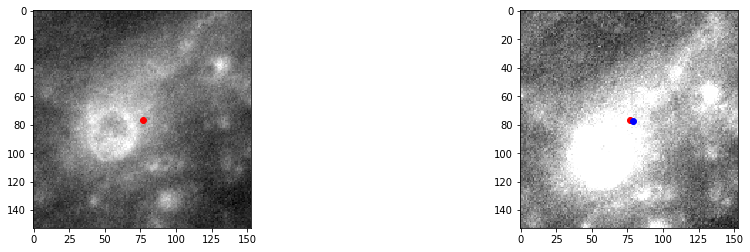
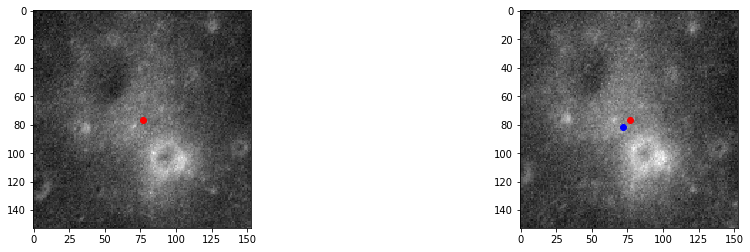
This is a 100% experiment with the Apollo Pan data. Is it possible to work at a silly reduced resolution and then subpixel match by scaling the correspondence to the correct place?
The first step is to visualize what is going to happen.
Scale the keypoint to full resolution
Extract a search template from one of the images
Extract a search space from the other image
Upsample each using a non-linear interpolation (parabola basically)
Apply a standard normalized cross correlation metric to determine the maximum correlation
In line # 28, below, an argument func=cv2.TM_CCORR_NORMED is being passed. This determines the metric that is used to compute the correlation between the search template and the search space. The default is to use a normalized correlation coefficient. This metric was not working well for the Apollo Pan data, so we pass a different computation function - the normalized cross correlation metric.
[4]:
from autocnet.matcher.subpixel import clip_roi, subpixel_offset
[39]:
import cv2
# Scale the keypoints coordinates back to full resolution.
for i, n in cg.nodes_iter(data=True):
    n.keypoints.x *= n['downsample_amount']
    n.keypoints.y *= n['downsample_amount']

# Apply the subpixel registration
#cg.subpixel_register(clean_keys=['fundamental'], tiled=True)
e = cg.edge[0][1]
img1 = e.source.geodata
img2 = e.destination.geodata

mask = cg.edge[0][1].masks.fundamental
matches = cg.edge[0][1].matches[mask]

size = 153

for i, r in matches.iterrows():
    sx, sy = e.source.get_keypoint_coordinates(r.source_idx)
    dx, dy = e.destination.get_keypoint_coordinates(r.destination_idx)
    fig, (ax1, ax2) = plt.subplots(1,2)
    sa = clip_roi(img1, (sx,sy), size)
    da = clip_roi(img2, (dx, dy), size)

    sa_temp = clip_roi(img1, (sx, sy), 17)
    da_space = clip_roi(img2, (dx, dy), 29)

    x_off, y_off, strength = subpixel_offset(sa_temp,da_space, func=cv2.TM_CCORR_NORMED)
    print(x_off, y_off, strength)
    ax1.imshow(sa, cmap='gray')
    ax1.plot(size/2, size/2, 'ro')
    ax2.imshow(da, cmap='gray')
    ax2.plot(size/2, size/2, 'ro')
    ax2.plot((size/2) + x_off, (size/2) + y_off, 'bo')
    show()

# Scale the keypoint coordinates back to the reduced resolution
for i, n in cg.nodes_iter(data=True):
    n.keypoints.x /= n['downsample_amount']
    n.keypoints.y /= n['downsample_amount']
4.9375 -1.375 0.9997124075889587
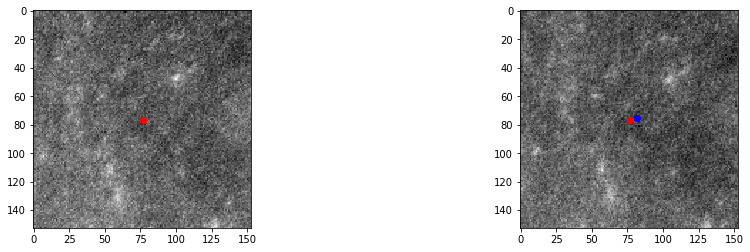
2.5 -3.1875 0.9997014999389648
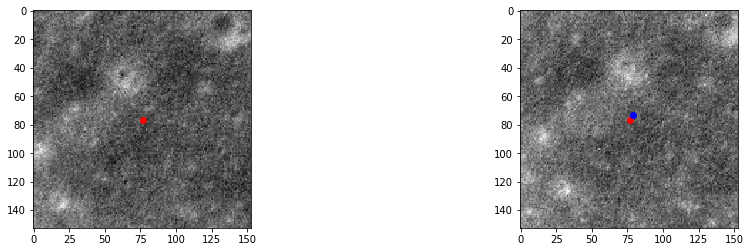
6.0 -0.0625 0.9997513890266418
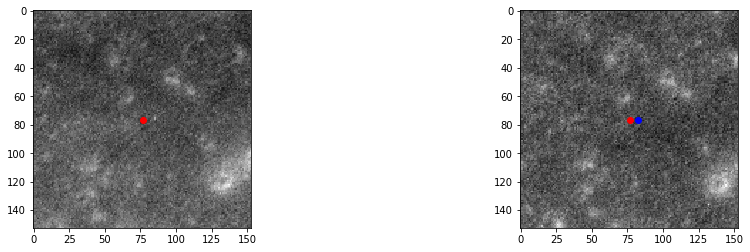
-1.75 -4.375 0.9997540712356567
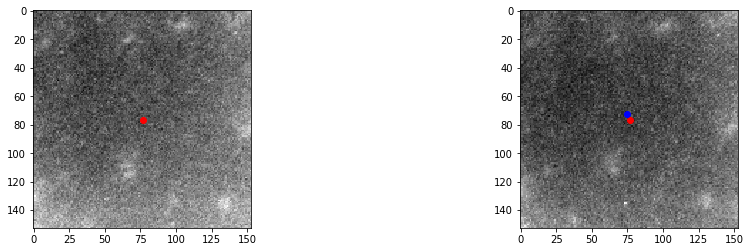
5.25 3.0625 0.9996282458305359
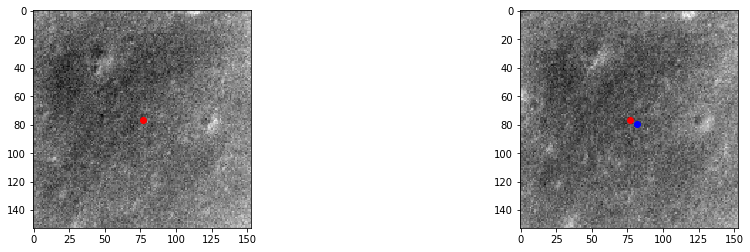
-2.75 4.3125 0.9997715353965759

-2.5 5.8125 0.9997096061706543
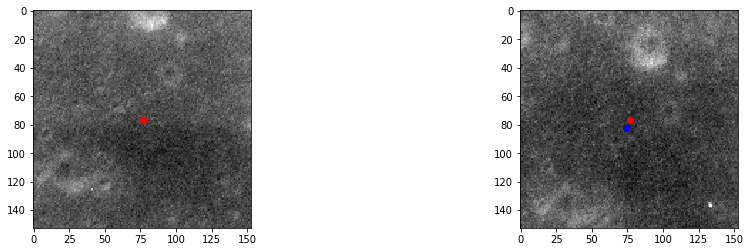
-1.8125 -2.5 0.9997724890708923
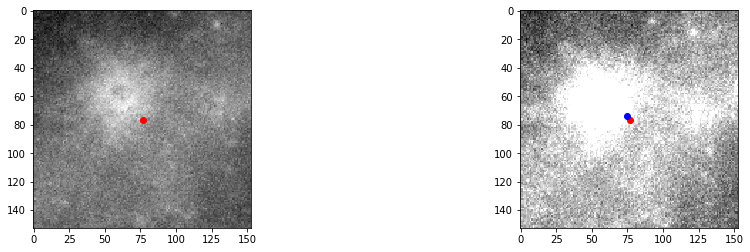
2.25 -3.0625 0.9996821880340576
-4.3125 4.75 0.9998062252998352
5.625 -6.0 0.9997365474700928
-1.25 -5.5625 0.9997563362121582
2.3125 0.5625 0.9995174407958984
-5.0 4.875 0.9997614622116089
-3.875 -6.0 0.9996576905250549